Safety briefing for a sailing yacht: the checklist
30 points in four sections that you go through with your crew before you cast off. In the app they are there to tick off, each with a note on what matters and space for your own remarks. Nothing gets forgotten, and your crew knows exactly where it stands.
The safety briefing that you and your crew will not forget
30 points covering every essential part of the safety briefing. The whole crew can see the list; only the skipper can tick items off and add notes.
- Always in your pocket. Easy to tick off, quick to look up. Nothing gets forgotten.
- Every point comes with concrete guidance. Not just “life raft”, but what you should say about it.
- Your own notes on every point. Add a note to any point and record whatever is particular to your boat.
- Add your own points. Every boat has its quirks. Add them to the section where they belong.
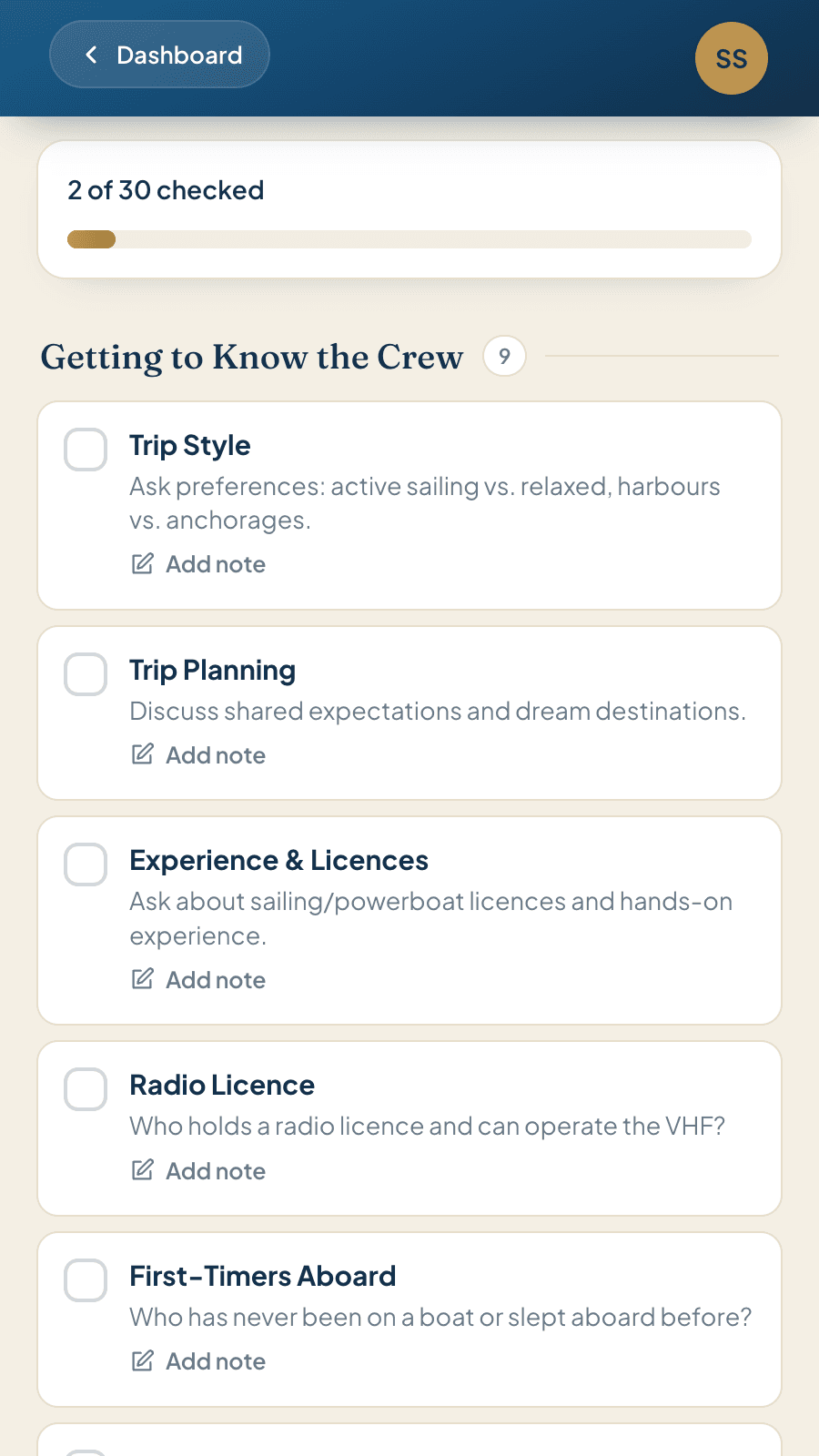
An extract from the safety briefing for sailing yachts
There is no strictly prescribed form for a safety briefing. What matters on a sailing yacht is that the crew knows where every piece of safety kit is, can move around safely on board, and that the skipper can judge how much they already know. That is exactly what our checklist is there for.
All 30 points to tick off
Every point comes with a note on what matters, plus space for your own remarks.
The mistakes almost every skipper makes
It is easily done. Details always slip during the safety briefing. Not out of carelessness, but because everything on handover day happens at the same time. That is the moment when something is most likely to be forgotten, and it is exactly the thing you really need when it counts.
Everything at once, minutes before casting off
Twenty minutes of safety briefing while the crew is already itching to leave is not ideal. Pick a calm moment, invite questions, explain it so that everyone on board understands it, and make sure every single crew member takes part.
It gets talked about, never touched
“The lifejackets are in the locker” is not a briefing. Everyone puts their own lifejacket on once, everyone clips on once, everyone opens the seacock once. The crew remembers far more that way, and in an emergency the hands move faster.
Not asked means not known
People who cannot swim rarely say so unprompted. Medication, allergies and seasickness only come up if the skipper actively asks. The answers go straight into a note, which makes the trip easier to plan and keeps it free of nasty surprises.
Nothing overlooked, all in one place
The 30 points of the safety briefing help you run your trip safely.
What to look out for during a safety briefing on a sailing yacht
Take the time to get to know your crew properly. Ask them how they are doing, and introduce yourself as their skipper. Put them at ease, then walk every single person through the safety essentials on board a sailing boat.
Get to know the crew: experience on sailing yachts, licences, swimming ability, allergies, medication, seasickness. This is a conversation, not an announcement, and it shapes how you handle situations later on.
Be calm and matter of fact when you talk about your experience in the area and as a skipper. Explain how you behave under pressure as well. All of it helps your crew build trust in you, and it lays the foundation for a good week together on board.
These are the things that come up first: heads, gas stove and shut-off valve, hatches and water. Best explained standing at the thing itself, letting everyone try it once. It saves a lot of questions later.
Have everyone put a lifejacket on, show the lifebelts and clipping-on points, go through the life raft, distress signals, the radio and the man overboard manoeuvre. Everything that has to work within seconds when it counts.
Winches, boat hook, lines, cleats, footwear and the rest. Give the crew the chance to try it straight away. The rest falls into place once you are sailing. What matters is the basic understanding at the start.
Is a safety briefing compulsory?
There is no legally prescribed form with fixed content for leisure and charter yachts. The skipper does carry the responsibility for boat and crew, though, and that includes everyone on board being able to find and use the safety equipment. What applies in your case depends on the flag, the sailing area and the charter agreement. If in doubt, ask at the base directly.
Common questions
What belongs in a safety briefing?
Four sections: getting to know the crew (experience, swimming ability, allergies, medication), introducing the skipper (responsibility, communication, expectations), the ground rules on board (one-hand rule, footwear, alcohol, man overboard) and the technical briefing (lifejackets, life raft, lifebelts, gas stove, heads, hatches, winches, cleats). Add your own points wherever you want to.
When do you do the safety briefing?
Whenever there is enough time for it. You can also spread it out. Getting to know each other works on the pontoon, the safety equipment before you cast off, winches and cleats on the first leg, the ground rules over the first evening. All that matters is that nothing is still open at the end of day one.
How long does a safety briefing take?
Around 45 to 60 minutes, spread across the first day. If it takes longer, that is not a problem. Better that it takes a while and everyone has understood it, than the skipper rattling through it between other jobs.
Is there a printable PDF checklist?
No. In Skipper Connect the list sits inside the trip: tickable across several days, with a note on every point, visible to the whole crew, and still there long after a sheet of paper would have got soaked.
Who can edit the list in the app?
Everyone on the trip can see the list. Ticking off and writing notes is down to whoever holds the skipper role in the crew list. If no skipper role has been assigned, nobody can edit the list.
How often should we practise a man overboard drill?
Once during the briefing, and once more under sail on the first day if the conditions allow it. Talking it through is not the same as doing it. Everyone should know who calls out, who points and keeps pointing, who throws the horseshoe and who reaches for the engine start. Add what your crew agreed as a note on the point.
What does it cost?
The safety briefing is part of the Pro unlock. In a free trip you get a preview so you can look through it; the full list with notes becomes editable once you unlock. See pricing
On board with you
Pack, organise, shop, cook, navigate, settle up. Twelve features, one account. No more spreadsheets.
There is more to a trip than the safety briefing
Crew list, packing list, shopping, boat kitty, logbook and mileage record: twelve modules in one account.
Try it now